Best Smart Blinds Compatible with Alexa & Google Home in UAE
The demand for smart home automation in the UAE is rising for energy efficiency, security, and a luxurious lifestyle. Smart blinds add comfort, convenience, and a stylish look to your…

Window blinds improve the beauty as well as the practicality through light control, privacy, and energy efficiency. To get these benefits, you must know the art of closing your window shades properly. This will not only protect against sun damage but also be necessary for security by blocking outside views.
Additionally, proper handling of these functional blinds will facilitate work without causing damage. This will ensure the longevity of blinds. But all blinds have different operating mechanisms via cords, chains, or motors. So, how to close blinds is a simple trick after you understand the type and design of your window treatment. Let’s discuss the different types of window shades and their working mechanism.

The primary purpose of blinds is to cover windows beautifully. You can distinguish these window blinds by their difference in building material, functionality, and the methods by which they operate for controlling light & privacy. The important thing is to identify the type of your window blinds. before you learn how to lower blinds. Here is a list of common types of blinds that use basic methods such as sliding, lifting, and tilting.

To learn how to take down blinds using proper methods, here are step-by-step instructions.
Start by identifying the operating mechanism of your blinds. This will be the first step, and you will learn how you would control these shades for your benefit. Every window blind needs a different system. Some can be easily operated with cords, some need chains, and some are operated with a remote control.
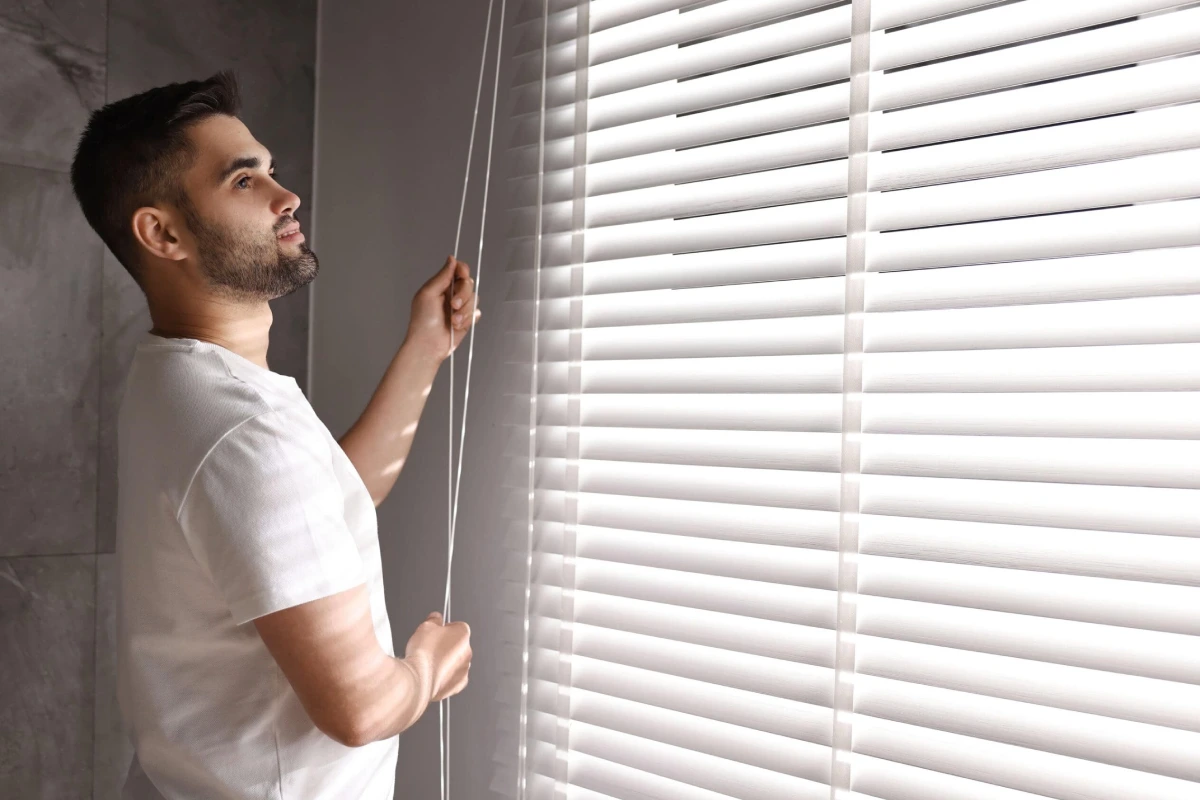
After you understand that your Venetian blinds have a cord-and-wand mechanism for raising and lowering them, or adjusting the slats. Then hold the wand in your hand.
If you want to take the blinds down, pull the strings down (45 degrees toward the inside of the window) that are usually located on the right side of the shades. These blinds will be lowered to cover the windows.
To adjust the slats, twist the wand clockwise; the slats will rotate until they stop where you need them. To close the slats, rotate the wand anticlockwise.
If you want to maintain daytime privacy, angle the slats and stop rotating the wand when they are slightly angled facing upward. This will allow light penetration for a refreshing feel. For complete closure & 100% privacy, fully close the slats with their upper convex part visible by twisting the wand.
For even closing, do not adjust the slats before the blinds are fully lowered. If there is any difference, lower your hands slightly and adjust the bottom rail until it rests evenly on the bottom.

For those looking for the right technique to pull down vertical blinds, follow the steps below. These are usually used on large windows and on sliding doors. They have two operating systems: one uses the wand and the other uses the cord & chain system. To rotate the slats correctly, twist the wand until the slats overlap. Then pull the wand to fully close the blinds for privacy.
If your blinds have a cord-and-chain mechanism, first close the slats using the beaded chains. By pulling these chains, the vertical slats will glide to overlap the other slats. To lower the blinds, pull the cord until they fully cover the window.
Before you learn how to close vertical blinds, you must know the operating system of these blinds. This will help you overcome the common issues while closing the blinds. Misaligned slats will look awkward, so adjust them slowly until they are even and point in the same direction. You can adjust them manually if the slats are misaligned. Keep the slats clean and dust them regularly to ensure smooth lowering and prevent gaming.
For roller blinds, the pull-down mechanism is explained for your convenience. For chain-driven rolling blinds, pull the chain present at the back of the fabric panels down to fully close the blind. Do this in slow motion to avoid uneven rolling. For cordless blinds, hold the center of the bottom rail and pull it towards the lower side of the window. Move slowly till it locks in its place.
Some roller blinds are operated by a wand; in that case, twist the wand to close the blind. In motorized roller shades, the remote control has a button for this action. Press the down button, and your blinds will close fully in no time.
Using cords or chain controls would make it easier to lower the fabric blinds for light control. To achieve its neat fabric pleats, the process should be handled slowly. This will improve the smooth closing at the right place. For cordless options, gently pull the blinds by hand.
To release the cord-lock mechanism, first release the lock. To do this, hold the cord in your hands and pull it towards the outer edge of the blind to open the lock. Then slowly remove the pressure on the cords. These loose cords will lower the blinds. If you want to lock the blind at a certain height, for light filtration, pull the cord inside the blind. This will stick the blinds, and you can enjoy an airy and bright place. For complete closure, repeat the process to unlock the cord and then lower the blind.
In case of uneven sides of blinds, adjust the fabrics with your hands. If the system is not operating properly, then look for the problem first. When the cords are stuck, pull them left and downwards to open the lock.
For homes with kids and pets, cordless blinds are commonly used because of the lower chances of dangling cords. Pets can harm themselves by scratching or biting the cords. Sometimes they get injured by twisting the cords around their necks. For optimal operation and additional benefits, you must understand how to pull down blinds without cords. These are usually open or closed with a pull-down or push-up method.
The slats in cordless blinds can be adjusted to the desired angle using the tilting mechanism, either by hand or by twisting the provided wand. If you need to adjust the slat by hand, tilt the lowest slat.

By following the tips below, you can improve the efficiency of your blinds. Moreover, you will get additional benefits, so be careful while closing your shades.

Sometimes, your blinds don’t work properly even if you are well aware of their mechanism. Here is the list we have sorted for you. Read out the pin problems so you can handle them without major issues.

If you want to maintain your blinds in the best condition with efficient working capability. Here are some maintenance tips for busy owners who want to keep their windows in good condition with minimal effort.
We have discussed the most accurate methods for operating different types of blinds. By adopting these techniques, you will enhance the practicality of these blinds for efficient light control and privacy. Whether your shades have a cord, a wand, a chain, or a cordless system, gently close the slats/panels to ensure a smooth process. To determine the right method for taking down your blind, first identify the type of blind. If blinds are closed properly, they will help regulate temperature during the day and prevent light from escaping at night without compromising comfort.