Best Smart Blinds Compatible with Alexa & Google Home in UAE
The demand for smart home automation in the UAE is rising for energy efficiency, security, and a luxurious lifestyle. Smart blinds add comfort, convenience, and a stylish look to your…


Accurate measurements are crucial for perfect-fitting blinds to acquire efficient light control, privacy, and insulation. Tailored-fit shades offer full coverage, adding style and utmost elegance to any space.
People often make common mistakes when measuring blinds, which leads to extra cost and effort. Lack of focus on the window shape, mounting type, and depth is a major blunder. Inaccurate measurement will result in an undersized or extra-large blind that looks awkward and incomplete.
For those who seek to learn how to measure for blinds, we are going to describe the correct ways to take the dimensions of windows. We also help readers understand the steps for measuringwindow shades for an accurate fit.

Window blinds combine beauty and practicality with their sleek look and easy-to-operate mechanisms. To explore the accurate methods for measuring blinds, you must understand different varieties. Here is the overview of popular blind types.
The measurement requirements vary by blind style and whether they mount inside or outside of the window. Window size and shape also matter when accounting for gaps, obstacles, and full coverage. Before choosing the right window treatment for better functionality, it is essential to learn how to measure windows for blinds.

When you fit the window blinds on the inner side of the window frame, this is called the inside mount. This style is best for windows having sufficient depth. The inside mount shades give a clean, modern, and sleek look. This could be a good practice for the small rooms, as they save space and do not give a bulky or crowded feel.
Outside-mount blinds are fitted to the outer edge of the window frame to fully cover the frame and prevent light gaps. It is suitable for windows with less depth, locks, and handles.
But it is a little tricky to choose the right mount for your window. It depends on your space requirement also. For a modern look, an inside mount will be a space-saving option for smaller spaces. You can select the outside mount blinds for the windows with handles and locks to ensure a smooth appearance.

While purchasing blinds, it is crucial to learn how to measure blinds with the right tools. Here is the list of tools you must have in your space before you plan to buy window blinds.
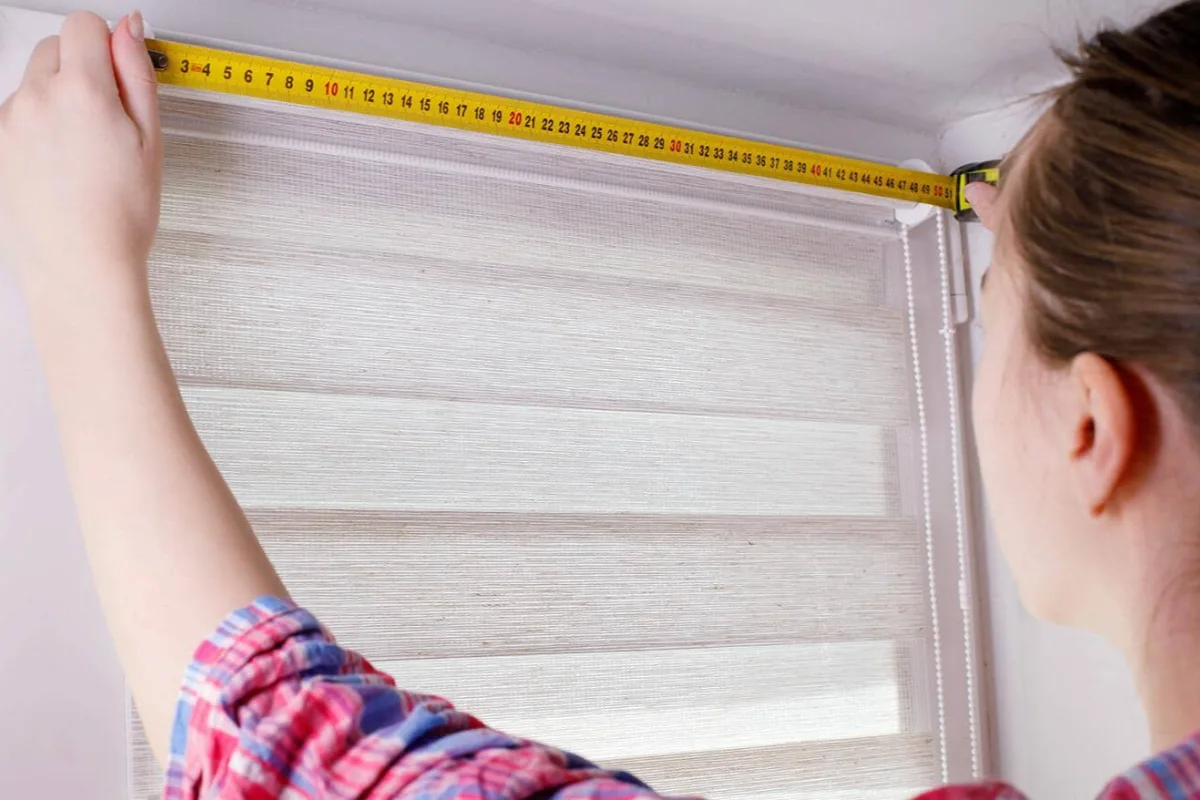
The measurement process is simple but requires attention to avoid errors. When you decide to measure the windows for inside-mount blinds, follow the step-by-step process described below.
Using metal tape, start measuring the window frame horizontally from one end to the other end of the frame. Take dimensions from three different places horizontally on the window. First at the top, second from the middle, and the third from the bottom of the window recess. Note all dimensions to ensure a smooth process.
Pick the smallest amount to get the super-fit blinds within the window frame without scratching or applying extra pressure.
For measuring window length, take three dimensions vertically from the left, middle, and right sides of the frame. Pick the largest figure for these three measurements. This will ensure proper coverage of your window.
For bracket fitting, ensure there is sufficient depth, accounting for the space between the inside of the frame and the outer edge of the window. For irregular windows, always take the smallest width and largest length to ensure a snug fit and no light gaps. Round down the ⅛ inch to the window length and round up ⅛ to the window width for precision adjustment or margin to make changes further.

For measuring the windows for the outside mount, follow these steps.
Measure the width using the appropriate measuring tool. Starting from one end of the frame to the other side of the window frame. Add 2-4 inches to this measurement to get the full width of your outside-mount window blinds for full coverage. 1 to 2 inches on each side of the frame will give a sufficient space to cover the gaps.
For proper light control, measure the windows vertically from the upper end of the frame to the lower window sill. Add 3 inches to the upper edge of the window frame for the headrail.
After measuring the drop and right width of your window blind, think about the overlap for reducing gaps on all sides, ensuring light blockage. So, add 3 inches to all sides of the window dimension. When your windows have irregular sides or obstructions, an outside mount is the better choice.

The style of your blinds affects the measurement. If you are interested in knowing the right measuring technique for a specific style, then learn how to measure for window blinds accurately. Given below are the expert tips you must be aware of.
The depth depends on the slat size. Wider slats need more space than narrower (25mm). For an inside mount, a depth of 5-7 cm is sufficient to allow easy adjustment of the slats. After you take the dimensions of width and drop, deduct 20mm approximately from the total width and add 120mm to the length. This is essential for drop accuracy, ensuring control over light and operating blinds without any hindrance. As these venetian blinds are heavy, they must be fitted in a space that supports it.
For the final measurement, leave enough space for fabric stacking. Take three measurements for the width and select the smallest one for the depth. For length, also take dimensions from the right, centre, and left sides of the window inside the frame. Take the smallest measurement.
To ensure it is fully adjusted to minimise gaps and improve functionality, deduct 5-10mm from the final measurements as an allowance.
Outside-mount Roman blinds make your space feel wider and bigger. These are suitable for shallow window recesses. Add 10-15 cm extra to the length for folding up the fabric. This will provide enough space for the view clearance when the blinds are folded.

Not all the windows in your space are of the same size and shape. For special windows like bay, corner, small, narrow, or extra wide, you need some help from professionals. But here, we want to share some DIY tips for how to measure windows for special shapes & sliding doors.
If your window is a bay, then consider every window as a single window. Measure the dimension as you measure the standard square window. Do not forget to consider the angles for the headrails and the shared brackets.
To measure the corner windows, consider both parts as separate windows. Measure the depth from three different places and select the smallest calculation. Then repeat the process on the second part.
For the drop calculation, measure from three different places on both parts of the window, accounting for the sufficient depth.
The blinds improve the functionality & elegance of the space when mounted outside the window on the door trim or wall. While measuring these doors for blinds, take the width from the top, middle, and bottom. Then select the largest width and add 3-5 inches of extra length for sufficient overlap and better light blockage.
For the length, take measurements from the left, middle, and right corners. Then take the largest length and add 2-4 inches for the track mounting.

While measuring blinds for accurate fitting, you may make mistakes, which can lead to repairs or replacements. This will not only damage the look but also waste time and money. To avoid these mistakes, have a look at them.
Precise measurement is essential for the proper fitting of blinds on any type of window. Here are some expert tips for avoiding mistakes and achieving perfect fixing and seamless blending.
If your windows are large, curved, or angled, then follow the manufacturer’s measurement guidelines to avoid any errors.
To measure the windows for blinds, first arrange the right tools. Then consider the type of your window and its style, whether mounting outside or inside. For precise calculation, take the width and length from three places. Taking the highest figure, subtract ⅛ inch from the depth and add ⅛ inch to the length for an inside fit. Add 2-4 inches for the track fitting in the outside mount. Correct measurements are important for the snug-fit blinds that improve aesthetics and function. Be sure to measure windows before ordering blinds.